“Everybody is a genius. But if you judge a fish by its ability to climb a tree, it will live its whole life believing that it is stupid.”
Albert Einstein
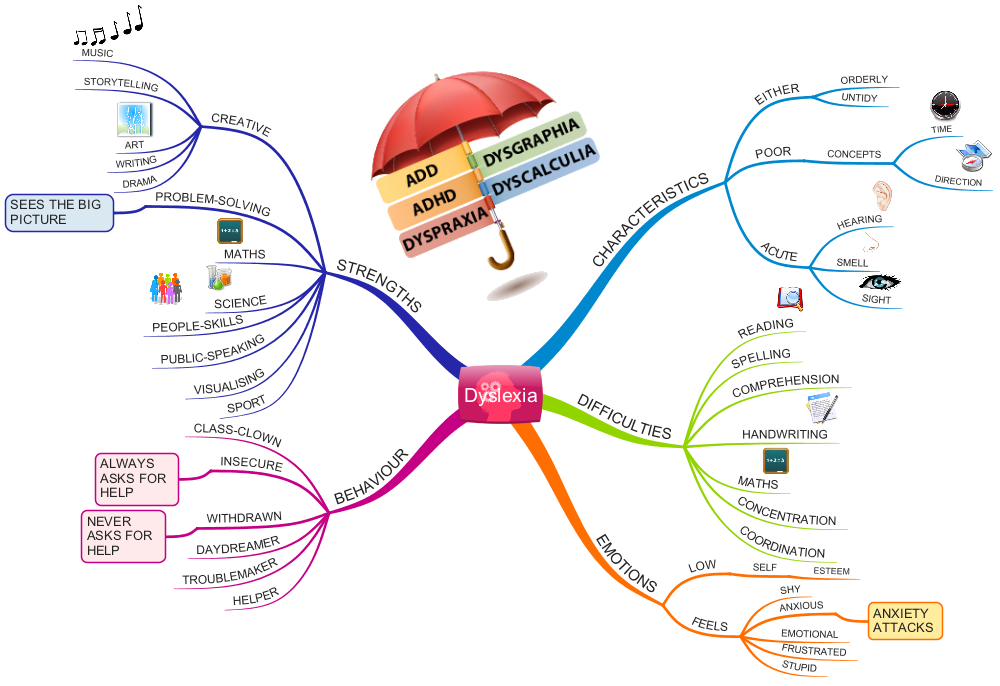
Click on the mindmap for a full size version.
© Gillian Tyler and Jan Stead 2015 used with permission
At its most basic level, the word ‘dyslexia’ simply means difficulty with words. First coined in the late 1880s it was defined as “an inability to learn to read occurring in an otherwise bright and devel
What is Dyslexia?
Dyslexia is often described as a difficulty with reading and words—but for many children and adults, it feels like much more.
It can look like:
- Struggling to read, spell, or write despite trying hard
- Falling behind at school or avoiding learning tasks
- Low confidence, frustration, or anxiety
- Being bright, capable—and misunderstood
If you’re a parent or teacher, you may have seen this firsthand: a child who is intelligent and creative, yet not thriving in a traditional learning environment.
A Modern Understanding
Dyslexia is not a sign of low ability. It’s a different way of thinking and processing information.
Many people with dyslexia are strong visual thinkers, problem-solvers, and creative minds. But without the right support, their challenges can overshadow their strengths.
Dyslexia and Neurodiversity
Dyslexia is part of neurodiversity—the natural variation in how people learn and process the world.
It often occurs alongside other differences, such as:
- ADHD (attention and focus challenges)
- Dyspraxia (coordination and organisation difficulties)
- Dysgraphia (writing challenges)
- Dyscalculia (maths difficulties)
- Working memory challenges
- Auditory Processing Disorder (APD)
- Anxiety
Every dyslexic is unique—and a one-size-fits-all approach simply doesn’t work.
How I Can Help
At Dyslexia Unlocked, I take a personalised, strengths-based approach to learning.
Whether you’re a parent or grandparent looking for answers, or a teacher supporting a student, I offer practical, evidence-based programs designed to:
- Build confidence and self-esteem
- Improve reading, writing, and comprehension
- Develop focus and learning strategies
- Reduce frustration and overwhelm
My work draws on the proven Davis Method® with different programs as needed, tailored to each individual.
Take the First Step

You don’t have to figure this out alone.
If something doesn’t feel right, or you know a child (or yourself) isn’t reaching their potential, let’s talk.
Book a free discovery call to:
- Share your concerns
- Ask questions
- Explore the right support options
Together, we can create a path forward that makes learning easier—and more enjoyable.